

SCHOLARSHIP APPLICATION: (Deadline: APRIL 30th, 2027)
Please ensure all fields are filled in completely.To view previous winner: Click Here
(IF YOU HAVE ANY QUESTIONS, PLEASE EMAIL THE PROGRAM ADMINISTRATOR AT RYAN@STUDENTSCHOLARSHIPS.ORG)
Forklift Mast Bearing
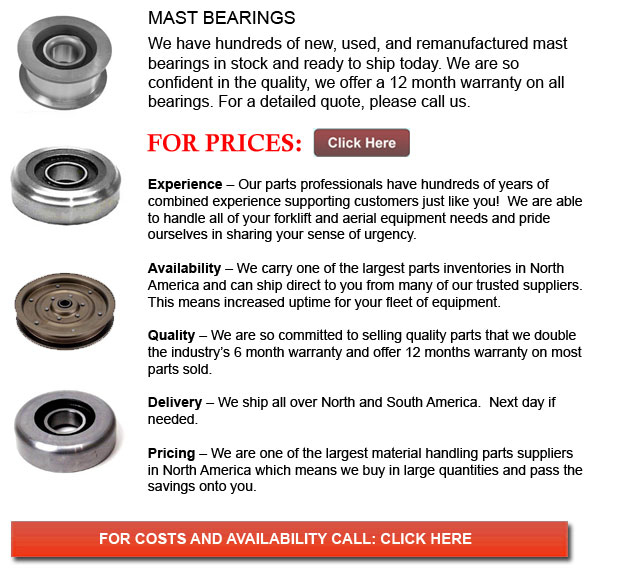

Mast Bearings - A bearing is a gadget that enables constrained relative motion between two or more parts, normally in a rotational or linear procession. They could be broadly defined by the motions they permit, the directions of applied cargo they can take and according to their nature of operation.
Plain bearings are extremely widely utilized. They utilize surfaces in rubbing contact, normally with a lubricant like for instance oil or graphite. Plain bearings may or may not be considered a discrete tool. A plain bearing may have a planar surface that bears another, and in this particular case will be defined as not a discrete gadget. It may consist of nothing more than the bearing surface of a hole with a shaft passing through it. A semi-discrete example will be a layer of bearing metal fused to the substrate, whereas in the form of a separable sleeve, it would be a discrete device. Maintaining the correct lubrication enables plain bearings to provide acceptable accuracy and friction at minimal expense.
There are various kinds of bearings which can enhance accuracy, reliability and develop efficiency. In various uses, a more fitting and specific bearing could better service intervals, weight, size, and operation speed, therefore lowering the total costs of using and buying equipment.
Several types of bearings together with varying lubrication, shape, material and application exist in the market. Rolling-element bearings, for example, make use of drums or spheres rolling among the components in order to lessen friction. Less friction gives tighter tolerances and higher precision compared to plain bearings, and less wear extends machine accuracy.
Plain bearings are usually made utilizing different types of plastic or metal, depending on how corrosive or dirty the environment is and depending upon the load itself. The type and use of lubricants can considerably affect bearing friction and lifespan. For example, a bearing may work without whichever lubricant if constant lubrication is not an alternative because the lubricants can draw dirt that damages the bearings or tools. Or a lubricant could improve bearing friction but in the food processing business, it may need being lubricated by an inferior, yet food-safe lube in order to prevent food contamination and guarantee health safety.
Nearly all high-cycle application bearings need cleaning and some lubrication. Sometimes, they could need adjustments in order to help lessen the effects of wear. Some bearings could require irregular maintenance so as to prevent premature failure, though fluid or magnetic bearings could require not much preservation.
Extending bearing life is often attained if the bearing is kept well-lubricated and clean, though, several types of utilization make consistent repairs a difficult task. Bearings located in a conveyor of a rock crusher for example, are constantly exposed to abrasive particles. Frequent cleaning is of little use as the cleaning operation is pricey and the bearing becomes dirty once more once the conveyor continues operation.
Click to Download the PDF
Forklift Parts


TOLL FREE: 1-888-695-7994
Wilmington, Delaware
forkliftpartswilmington.com
Email Us
About Us